
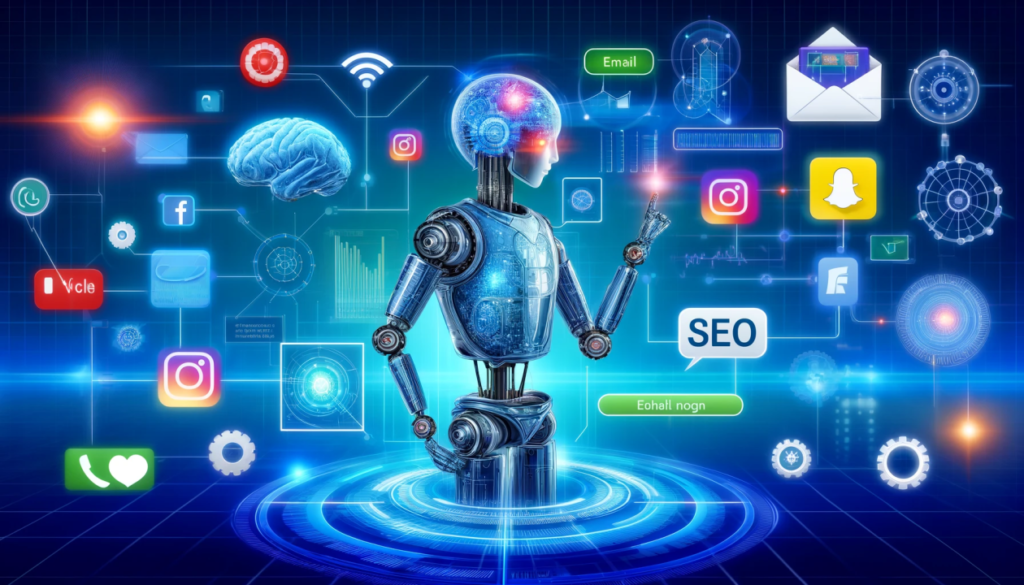
AI in Digital Marketing: Opportunities, Challenges & Future Trends
The digital marketing landscape is changing rapidly, and Artificial Intelligence (AI) has become one of the most powerful technologies driving this transformation. AI is helping businesses understand their customers better, automate repetitive tasks, improve marketing campaigns, and make smarter, data-driven decisions.
For businesses in Kerala, adopting AI-powered digital marketing strategies can create new opportunities for better visibility, stronger customer engagement, and sustainable business growth.
What Is AI in Digital Marketing?
AI in digital marketing refers to the use of intelligent technologies such as machine learning, predictive analytics, automation, and data analysis to improve marketing activities.
Instead of depending entirely on assumptions, marketers can use AI to understand customer behavior, identify patterns, predict future actions, and optimize campaigns.
Common examples include:
- Personalized advertisements based on online behavior
- Product recommendations on e-commerce websites
- Personalized email campaigns
- Automated customer support through chatbots
- AI-powered content and keyword analysis
AI allows businesses to deliver the right message to the right audience at the right time.
Why Is AI Important in Digital Marketing?
Digital competition is increasing every day. Customers interact with brands through search engines, social media, websites, email, and online advertisements. Businesses therefore need marketing strategies that are faster, more personalized, and more efficient.
AI helps marketers:
- Understand customer behavior
- Identify potential customers
- Personalize marketing experiences
- Automate repetitive activities
- Optimize advertising campaigns
- Improve website performance
- Analyze marketing data
- Increase overall marketing efficiency
The combination of technology, data, and human creativity allows businesses to build more effective digital strategies.
Opportunities of AI in Digital Marketing
1. Better Customer Insights
One of the major advantages of AI is its ability to process large amounts of customer data quickly.
AI can analyze:
- Website browsing behavior
- Purchase history
- Search activity
- Click patterns
- Social media interactions
- Customer engagement
These insights help businesses understand what their customers want and how they interact with a brand.
Marketers can use this information to identify high-intent audiences, understand customer preferences, discover conversion problems, and create more targeted campaigns.
2. Personalization at Scale
Customers increasingly expect brands to provide experiences that are relevant to their interests.
AI makes large-scale personalization possible by helping businesses:
- Recommend relevant products
- Personalize email content
- Display dynamic website content
- Create targeted advertisements
- Segment audiences automatically
For example, customers who frequently interact with a particular type of product or service can receive marketing messages specifically related to their interests.
Personalized marketing can improve customer satisfaction, engagement, loyalty, and conversion opportunities.
3. Marketing Automation
AI-powered automation allows businesses to reduce manual work and improve marketing efficiency.
Several marketing activities can be automated, including:
- Email campaigns
- Social media scheduling
- Lead nurturing
- Customer responses
- Advertising optimization
- Follow-up messages
Automation allows businesses to maintain consistency while giving marketers more time to focus on strategy, creativity, and business development.
4. Smarter Content Creation
AI has become a useful assistant for content marketers. It can support marketers with:
- Blog topic ideas
- Advertisement copy
- Social media captions
- Content optimization
- Keyword research
- Competitor analysis
- Content gap analysis
However, AI should support human creativity rather than completely replace it.
Strong marketing content still requires storytelling, originality, emotional connection, cultural understanding, and a clear brand voice.
5. Predictive Analytics
Predictive analytics uses historical and behavioral data to identify possible future outcomes.
AI can help businesses predict:
- Which leads are more likely to convert
- Changes in customer demand
- Possible customer churn
- Seasonal trends
- Potential campaign performance
These insights can help businesses allocate their budgets more effectively, reduce unnecessary spending, and improve marketing performance.
6. AI Chatbots and Customer Support
Customers often expect immediate responses when interacting with businesses online.
AI-powered chatbots can provide support around the clock by:
- Answering common questions
- Providing instant responses
- Guiding customers through purchases
- Collecting basic information
- Supporting lead generation
This can improve customer experience while reducing the amount of repetitive work handled manually.
7. AI-Powered Advertising
Modern advertising platforms use AI to optimize campaigns based on performance data.
AI can assist with:
- Audience targeting
- Smart bidding
- Ad placement
- Budget optimization
- Campaign adjustments
- Performance analysis
Platforms such as Google Ads and Meta Ads use automated systems to help advertisers identify valuable audiences and improve campaign performance.
Challenges of AI in Digital Marketing
Although AI provides significant opportunities, businesses must also understand its limitations and risks.
1. Data Privacy and Security
AI systems often depend on customer information and behavioral data.
Poor data management can create risks such as:
- Privacy violations
- Loss of customer trust
- Security problems
- Regulatory concerns
Businesses should handle customer data responsibly and maintain transparency about how information is collected and used.
2. Implementation Costs
Implementing AI may require investment in:
- Software and AI tools
- Technology infrastructure
- Skilled professionals
- Training
- Maintenance
For small businesses, these costs can initially appear challenging. A clear strategy is important to ensure that AI investments generate meaningful business value.
3. Limited Human Creativity and Emotional Understanding
AI can process information and recognize patterns, but marketing is also about human emotions and relationships.
Successful marketing requires:
- Creativity
- Storytelling
- Empathy
- Cultural understanding
- Emotional intelligence
- Brand personality
Overdependence on AI can result in content that feels repetitive, generic, or disconnected from the audience.
The strongest approach is to combine AI capabilities with human creativity.
4. Skill Gaps and Training
Businesses need professionals who understand both digital marketing and AI technologies.
Important skills include:
- Data analysis
- SEO
- Marketing automation
- Performance marketing
- AI tool management
- Digital strategy
Continuous learning and training are becoming increasingly important as AI technologies continue to evolve.
5. Ethical and Bias Concerns
AI systems can sometimes produce biased results because of limitations or biases within the data used to train them.
This may result in:
- Unfair audience targeting
- Exclusion of certain customer groups
- Inappropriate recommendations
- Ethical concerns
Businesses should regularly monitor AI systems and use them responsibly.
How AI Is Changing SEO
Search Engine Optimization is another area being significantly influenced by AI.
AI-powered tools can support marketers with:
- Keyword research
- Search intent analysis
- Competitor research
- Technical SEO audits
- Content gap analysis
- Content optimization
AI can help identify search patterns and opportunities more efficiently than manual analysis alone.
It can also assist with:
- Meta titles
- Meta descriptions
- Internal linking
- Content readability
- User experience improvements
When used strategically, AI can help businesses improve their search visibility and build stronger organic traffic strategies.
AI in Social Media Marketing
Social media platforms rely heavily on algorithms to determine which content users see.
AI can help businesses analyze:
- Audience engagement
- Best posting times
- Content performance
- Emerging trends
- Social media sentiment
- Advertising performance
AI can also support:
- Automated responses
- Direct-message management
- Influencer identification
- Performance tracking
- Audience analysis
This allows businesses to maintain a more consistent and data-driven social media presence.
AI for Lead Generation and Conversion
Generating leads is only the first step. Converting those leads into customers is equally important.
AI can help businesses:
- Score leads based on behavior
- Identify high-intent visitors
- Personalize landing pages
- Automate follow-ups
- Analyze conversion patterns
For example, if a visitor repeatedly interacts with a particular service page, AI-powered systems can identify that behavior and trigger a relevant follow-up action.
This can help businesses improve conversion rates and make their marketing campaigns more efficient.
AI in Email Marketing
Email marketing continues to be an important digital marketing channel, and AI can make email campaigns more personalized and efficient.
AI can help marketers:
- Identify suitable sending times
- Personalize subject lines
- Segment audiences
- Analyze open rates
- Study click behavior
- Recommend relevant content
Instead of sending the same message to every subscriber, businesses can use AI to create more relevant experiences for different audience groups.
AI for Small Businesses in Kerala
AI is not limited to large corporations. Small businesses and local entrepreneurs can also benefit from affordable AI-powered tools.
Businesses in Kerala can use AI for:
- Local SEO
- Google Business Profile optimization
- Customer communication
- Advertising targeting
- Website analysis
- Lead generation
- Content planning
With the right strategy, AI can help small businesses compete more effectively by improving efficiency and reducing unnecessary marketing effort.
The Human + AI Formula
AI can provide speed, automation, and data intelligence, but human expertise remains essential.
Successful marketing requires:
- Emotional storytelling
- Strategic thinking
- Brand positioning
- Cultural understanding
- Creativity
- Authentic communication
The most effective formula is:
AI Efficiency + Human Creativity + Strategic Marketing
AI should not be viewed simply as a replacement for marketers. Instead, it should be used as a powerful tool that helps marketers work smarter and make better decisions.
Future of AI in Digital Marketing
AI technology is expected to continue influencing digital marketing in the coming years.
Important trends include:
- Voice search optimization
- AI-powered video creation and editing
- Visual search
- Augmented Reality marketing
- Hyper-personalized customer experiences
- Advanced predictive analytics
- Automated campaign optimization
Businesses that understand and adopt these technologies strategically can improve customer experiences, strengthen their digital presence, and gain a competitive advantage.
How Kerala Businesses Can Use AI Effectively
Local businesses, startups, and entrepreneurs can begin their AI journey by identifying areas where automation and data analysis can create the greatest impact.
They can use AI to:
- Strengthen local SEO
- Reach specific regional audiences
- Improve advertising efficiency
- Automate lead generation
- Analyze website performance
- Improve customer engagement
- Create personalized marketing campaigns
The goal should not be to use AI simply because it is a new technology. Businesses should identify real marketing problems and use AI where it can provide measurable value.
Why Businesses Should Adapt to AI
Digital competition is growing rapidly. Businesses that fail to adapt to new technologies may struggle with visibility, customer engagement, advertising efficiency, and overall competitiveness.
Businesses that strategically adopt AI can:
- Improve operational efficiency
- Reduce marketing waste
- Understand customers better
- Improve conversion opportunities
- Strengthen their brand positioning
- Make more informed decisions
AI is not replacing the importance of marketers. It is giving marketers better tools to work with data, automate repetitive processes, and focus on strategic growth.
Conclusion
Artificial Intelligence is transforming digital marketing by changing how businesses understand customers, create content, manage campaigns, generate leads, and measure results.
The major opportunities include:
- Advanced customer insights
- Personalized marketing
- Automation
- Predictive analytics
- Smarter advertising
- Improved SEO
- Better customer support
At the same time, businesses must carefully manage challenges such as data privacy, implementation costs, skill gaps, ethical concerns, and overdependence on automation.
The future of digital marketing belongs to businesses that can successfully combine technology with human expertise.